When we look into a stockpot after six hours of simmering, we usually find a deeply flavorful, cloudy liquor. Fine bone dust, fragmented muscle fibers, emulsified fat droplets, and suspended proteins hang in the liquid, scattering light and muting color. For a hearty weekday stew, this opacity brings welcome body. Yet there are moments in the kitchen when we want absolute purity: a broth so clear that light travels straight through the bowl, illuminating every grain of garnish resting at the bottom. To achieve that jewel-like clarity, we turn to the traditional technique of the albumen raft.
Clarification is not merely an aesthetic trick; it alters how a broth feels against the palate. By coaxing egg whites to coagulate through a cold stock, we build an organic micro-filter that rises to the surface under gentle fire. As the liquid circulates through this buoyant mesh of tangled proteins, it drops its particulate baggage while absorbing subtle aromatic top notes from lean ground meat and minced roots. The work requires quiet attention, an understanding of heat transfer, and a willingness to leave the spoon at rest once the fire does its part.
The Mechanics Behind Protein Raft Clarification
The science of the raft rests on the thermal behavior of egg albumen. Egg whites consist of roughly water and globular proteins, primarily ovalbumin, ovotransferrin, and ovomucoid. In their native state, these protein molecules are curled into tight, compact spheres held together by delicate chemical bonds. When suspended in cold liquid, they disperse freely without binding to one another or interfering with the water molecules around them.
As we apply thermal energy to the pot, raising the liquid toward 140 degrees Fahrenheit, these globular chains begin to denature. Heat breaks the internal bonds, causing the tightly coiled strands to unfold into loose, jagged strings. As the temperature climbs between 145 and 160 degrees Fahrenheit, these exposed chains collide and cross-link, establishing a three-dimensional network known as a coagulum. Because air is trapped within the whipped whites and steam bubbles rise from the base of the pot, this dense lattice floats upward, consolidating into a thick, porous mattress on the liquid surface.
This floating filter works through both mechanical filtration and electrostatic attraction. The tiny spaces between cross-linked albumen strands trap particulate debris carried up by convection currents. Simultaneously, the exposed chemical groups on the unfolded proteins carry ionic charges that attract oppositely charged microscopic suspended solids, holding them fast. The following table illustrates how the components of our clearmeat mixture function during this thermal cycle:
| Component | Primary Material | Role in the Clarification Process |
|---|---|---|
| Egg Albumen | Pure egg whites | Forms the sticky, structural protein lattice that rises and captures micro-debris. |
| Lean Ground Meat | Shank, round, or breast (under 3 percent fat) | Supplies water-soluble proteins to replenish depth stripped by the whites. |
| Acidic Element | Tomato pulp, lemon juice, or dry white wine | Lowers pH slightly to accelerate protein denaturation and firm the raft matrix. |
| Brunoise Mirepoix | Finely cut leek, celery, and carrot | Disperses structural weight across the raft and perfumes the simmering liquid. |
Without lean meat and mirepoix, pure egg whites would strip a broth bare. Albumen does not discriminate between cloudiness and flavor; it traps flavor compounds and aromatic lipids along with bone grit. By introducing lean ground meat matching the broth base along with finely cut vegetables into our clearmeat, we establish an equilibrium. The stock yields its impurities to the rising whites while drinking in fresh gelatin, amino acids, and sweetness from the fresh ingredients.
Chilling the Base Broth to Solidify Surface Fat
Before we introduce a single egg white, our base broth must be completely cold, ideally resting between 34 and 38 degrees Fahrenheit. If we pour clearmeat into warm broth, the albumen coagulates instantly around the pour zone, creating dense clumps of poached egg white on the bottom of the pot instead of a unified, rising filter. Starting cold guarantees an even distribution of the uncoagulated proteins throughout the entire volume of liquid.
Temperature control also gives us our best opportunity to strip out fat. Fat is the enemy of a brilliant consommé. When fat boils alongside clarifying whites, the turbulent agitation emulsifies microscopic grease droplets back into the liquid, defying the trap of the raft and leaving a dull, greasy sheen on the surface. Chilling the strained stock overnight in an uncovered container allows the tallow, lard, or poultry schmaltz to rise to the top and set into a rigid, brittle disk.
To prepare the broth properly, we execute the following sequence:
- Chill the strained stock in an unreactive stainless steel or glazed earthenware vessel for at least eight hours until the surface fat sets hard.
- Lever a thin, flexible offset spatula around the perimeter of the pot to release the fat cap from the steel walls.
- Lift the hardened fat puck away in large shards, taking care not to push fragments back down into the gelatinized broth below.
- Dampen a clean piece of unbleached cheesecloth or linen with warm water, lay it gently across the surface of the cold stock jelly, and pull it away. The damp cloth captures lingering fat flakes and fine oils that escaped the blade.
If the stock was brewed from knuckles and feet, it will form a solid, quivering jelly at this temperature. Do not be alarmed by this firm consistency. As we apply fire, the gelatin liquefies long before the proteins reach their coagulation threshold, allowing the clearmeat to integrate thoroughly before the web forms.
Whipping Whites with Aromatic Vegetables
Building the clearmeat requires tactile sensitivity. We begin by separating our eggs while they are cold, ensuring not a single drop of yolk contaminates the albumen. Egg yolk contains lecithin and neutral lipids that weaken the protein matrix and cloud the final broth. For every two quarts of cold stock, we budget three to four large egg whites, eight ounces of double-ground lean meat, and four ounces of aromatic vegetables cut into a precise, tiny brunoise.
We do not want a dry, stiff meringue. Beating the whites to stiff peaks introduces excessive volume and large, brittle air bubbles that dry out over heat and cause the raft to fracture prematurely. Instead, place the whites in a wide copper or stainless steel bowl and whisk them with a balloon whisk just until the glassy transparency breaks into an opaque, foaming froth with soft, loose peaks. This stage requires about ninety seconds of brisk wrist action.
Next, we fold the cold ground meat, the brunoise of vegetables, a pinch of coarse salt, and a tablespoon of mild acid into the foamed whites using a wide rubber spatula. We use leeks instead of yellow onions because leeks contain fewer sulfur compounds that could overpower the delicate broth. Carrots must be cut fine; large chunks are too heavy for the rising foam and will tear through the albumen mesh, sinking back to the pan floor to scorch.
The resulting clearmeat mixture resembles a loose, wet paste. Pour the cold, degreased broth into a heavy, tall stockpot, preferably one with a spigot at the bottom if available. Whisk the clearmeat vigorously into the cold stock until the entire volume is uniform and cloudy. At this moment, the raw proteins are suspended across every cubic centimeter of liquid, ready to begin their collective ascent.
Piercing the Chimney Hole for Steam Release
Place the stockpot over low to medium-low heat. We never rush this climb; the transition from 38 degrees to 160 degrees Fahrenheit should take between twenty and twenty-five minutes. During this gradual warming, we run a flat-edged wooden paddle gently across the bottom of the pot every few minutes. This deliberate sweeping motion prevents the heavy, meat-laden whites from settling onto the metal base and caramelizing before they can rise.
Around 135 degrees Fahrenheit, the texture of the liquid changes. White flecks begin to gather on the surface like ice floes on a winter river. By 150 degrees, these floes knit together, pulling the ground meat and vegetables upward to create a thick, leathery crust that seals the top of the pot. The moment this solid raft locks into place, stop stirring completely. Any mechanical agitation from this point forward will tear the delicate protein lattice and cloud the broth permanently.
As the broth beneath the raft approaches a bare simmer at 180 to 185 degrees Fahrenheit, steam accumulates under the raft. Left alone, the trapped steam will eventually build enough pressure to erupt through the weakest section of the raft, flipping chunks of dirty egg white back into the clarified zone. We must provide an orderly exit path.
Take a clean, long-handled wooden spoon and hold it vertically above the center of the pot. Gently plunge the handle straight through the middle of the raft, pushing the coagulated meat and egg down until you see the shimmering, golden broth below. Swirl the handle in a small two-inch circle to form a neat, open chimney, then withdraw the spoon cleanly.
This chimney acts as our window and pressure valve. You will see broth bubbling gently within this opening, like water in a miniature volcanic crater. The hot broth rises through the chimney, spills out over the top of the raft, filters slowly down through the protein mesh, and returns to the base of the pot in a silent, continuous convective circuit. Adjust your flame until you see no more than three or four lazy bubbles breaking the surface of the chimney per minute. Maintain this serene pace for forty-five minutes to an hour.
Filtering the Liquid Through Unbleached Linen
When the clarification cycle concludes, the broth visible within our chimney hole will look remarkably bright, carrying the transparency of polished amber or pale tea. However, transferring this liquid out of the pot requires extreme caution. The underside of the raft holds onto a delicate sludge of captured solids that will easily dislodge if jostled.
We do not dump the pot through a colander. If you have a stockpot equipped with a low spigot, you may draw the liquid off in a thin, pencil-width stream directly into a waiting vessel. If you are using a standard pot, reach for a broad, shallow ladle. Press the ladle down into the chimney opening with minimal downward force, allowing the clarified liquid to pool over the ladle lip. Lift each measure out smoothly and pour it through your secondary filtration setup.
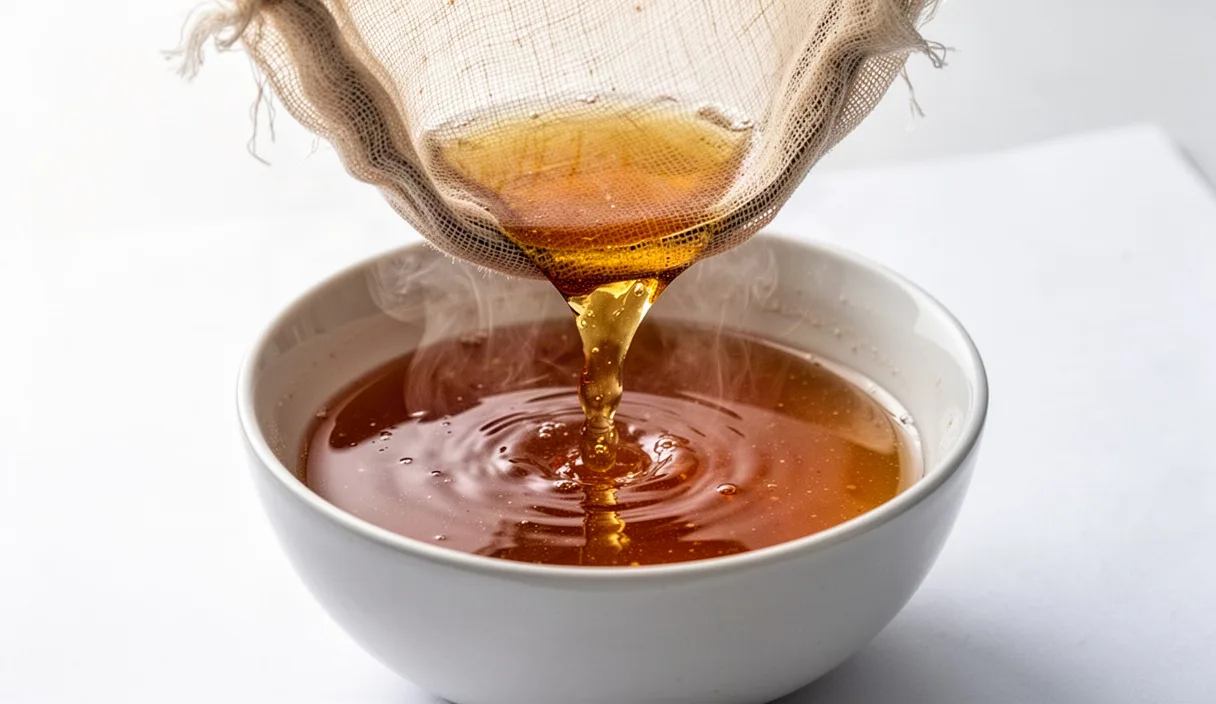
For our final pass, paper coffee filters are too dense and slow, while loose cheesecloth allows microscopic flecks to slip through. We prefer unbleached, high-thread-count linen or a thoroughly boiled cotton flour sack towel fitted over a fine-mesh chinois. Prepare the cloth following these precise measures:
- Wash the linen thoroughly in boiling water with a teaspoon of baking soda to remove any residual laundry detergent scents or sizing starch. Rinse it three times in cold running water.
- Wring the cloth out firmly. It must be damp, not dripping wet; a dry cloth absorbs the richest top fats and proteins, while a soaked cloth dilutes the first pint of broth.
- Line the metal chinois with the damp linen, securing the edges with clean wooden clothespins or binder clips to keep the cloth from slipping under the weight of the pour.
- Position the chinois over a heavy, pre-warmed ceramic or stainless steel bowl.
- Ladle the broth slowly against the sloped wall of the lined chinois rather than dropping it directly onto the base, which prevents splashing and preserves clarity.
Never, under any circumstance, press the raft remnants or squeeze the linen cloth to extract the last few ounces of liquid. Pressing forces the captured proteins and emulsified fats back through the weave, ruining the work of the previous two hours. Allow gravity alone to pull the clean consommé through the fibers.
Seasoning the Finished Consommé Correctly
A properly clarified broth plays tricks on our perceptions of salt and richness. During the clarification cycle, the egg albumen traps an appreciable amount of sodium ions, which means a stock that was perfectly seasoned beforehand often tastes surprisingly flat after passing through the raft. Furthermore, the total removal of emulsified fats strips away a tactile layer of mouthfeel that we often confuse with salinity.
We do not salt the pot while the raft is active. Mineral salts can alter the charge profile of the albumen chains, leading to a looser, more brittle matrix that degrades during the simmer. Instead, we season exclusively at the very end, once the liquid rests clean and warm in its finishing bowl.
Taste the hot broth using a warm ceramic spoon; cold metal chills the liquid and dampens your perception of delicate aromatics. Sprinkle fine sea salt or kosher salt in tiny increments, stirring gently with a wooden chopstick until the savory notes snap into focus. You will know you have reached the correct balance when the liquid no longer tastes thin or watery, but shows its full, rounded structure across the middle of your tongue.
If the mouthfeel seems too light because the base stock was lean on natural collagen, do not reach for industrial gelatin sheets immediately. A teaspoon of dry, unflavored gelatin bloomed in cold water and melted into the hot consommé can restore body, but a classic splash of dry fortified wine works wonders as well. Two tablespoons of dry Madeira, amontillado sherry, or white port stirred into two quarts of hot beef or game consommé cut through the intense savory notes and provide a round, wine-scented finish.
Common Mistakes
Working with albumen requires discipline. When a clarification fails, it usually traces back to one of several common missteps:
- Violent Boiling: If the flame is set too high, churning convection currents will tear the raft into shreds. The liquid becomes filled with cloudy gray flakes that no cloth can fully extract. Maintain an internal temperature between 180 and 185 degrees Fahrenheit.
- Stirring After Coagulation: Sweeping the pot is critical while the clearmeat warms from cold, but once the protein mesh knits into a solid mass at roughly 150 degrees Fahrenheit, any further agitation fractures the trap.
- Using Fatty Meats: Using standard ground chuck or chicken with skin in your clearmeat releases fresh grease into the simmering broth. Clearmeat meat must be absolute muscle tissue: beef round, venison shank, or skinless chicken breast stripped of all exterior fat.
- Skipping the Dampening Step: Laying dry cloth into your strainer will cause the initial pass of liquid to wick into dry fibers, pulling fines through before the cloth saturates, resulting in a hazy yield.
Next Steps
With a pristine, amber consommé resting in your kitchen, you have mastered one of classical cooking's most unforgiving foundational skills. To preserve its beauty, store the liquid in clean, airtight glass jars in the refrigerator for up to four days, or freeze it for three months; it will thaw with its clarity completely intact.
To serve, heat the consommé gently without allowing it to boil, which could cause trace proteins to haze. Consider serving it simply in warmed shallow bowls with a single, precisely executed garnish: a tangle of chervil leaves, paper-thin shavings of raw button mushrooms, or tender herb crêpe ribbons cut into a delicate chiffonade. The garnish should celebrate the medium, floating like a botanical study in a pool of clear liquid glass.