When we lift a seared pork chop, duck breast, or ribeye from the pan, our cooking is only half finished. Below the meat, bonded directly to the metal floor of the skillet, sits a concentrated deposit of dehydrated proteins, sugars, and rendered fats. In professional kitchens, we call this the fond. It looks like an uneven glaze of deep amber and russet, smelling of toasted marrow and caramelized alliums. That thin patina is the backbone of a true pan sauce, holding more complex savory notes than any carton of prepared stock could ever deliver.
Yet building a sauce directly on that hot cooking surface requires an intimate understanding of thermal momentum. A pan hot enough to brown muscle fibers can easily carbonize those same proteins within twenty seconds of removing the cut of meat. The craft of the saucier is not about secret ingredients; it is about reading the surface of the metal, moderating the burner flame, and catching the pan before the fond burns. We must treat the skillet as a responsive tool, using liquid, fat, and physical movement to manipulate heat in real time.
Recognizing the Line Between Fond and Scorched Metal
The boundary between an exceptional pan sauce and an acrid, bitter reduction is measured in degrees and seconds. Good fond is the product of the Maillard reaction, where amino acids and reducing sugars rearrange under heat, typically beginning around 280 degrees Fahrenheit and accelerating rapidly above 330 degrees. When properly formed, fond feels slightly tacky under a metal fork and displays colors ranging from warm copper to deep mahogany. It should smell nutty, sweet, and deeply savory.
Scorched metal, by contrast, occurs when surface temperatures exceed 400 degrees Fahrenheit without sufficient moisture to buffer the heat. At this threshold, pyrolysis takes over: proteins and carbohydrates decompose into raw carbon. The sheen disappears, replaced by a matte, chalky black finish. The aroma shifts sharply from toasted meat to the dry, stinging smell of an extinguished match or burned toast. If you deglaze over scorched fond, that acrid flavor dissolves directly into your sauce, and no amount of cream or cold butter can mask it.
| Characteristic | Usable Fond | Scorched Metal |
|---|---|---|
| Surface Hue | Chestnut brown, amber, deep russet | Matte black, dull gray carbon |
| Surface Texture | Glossy to semi-gloss, slightly tacky | Dry, chalky, flakes off as grit |
| Aroma | Nutty, rich, roasted, savory | Astringent, smoky, sharp, bitter |
| Corrective Action | Proceed immediately to deglazing | Discard pan contents and wipe clean |
We evaluate the state of the pan the instant the meat is transferred to a warm resting plate. If small patches along the outer perimeter have blackened while the center remains chestnut brown, we do not deglaze the entire pan blindly. Instead, we use a dry folded towel to wipe away the black rings before adding any liquid. If the central bed of fond itself has crossed into matte carbon, the correct decision is to set the pan aside, wipe it out completely, and start a fresh reduction with butter and minced shallots rather than serving a ruined sauce.
Managing Residual Heat in Heavy Stainless Steel
Most dedicated sauce-making takes place in clad stainless steel pans, usually built with three or five layers of metal where an aluminum or copper core is sandwiched between durable steel sheets. These pans are prized because they do not react with acidic liquids like wine or lemon juice. However, an exterior core of 2.6 to 3 millimeters of aluminum retains an immense reserve of latent energy. Even after you turn off the gas burner or induction ring, that thermal mass continues to radiate upward into whatever sits on the surface.
When we sear a steak, our pan floor may sit at 380 degrees Fahrenheit. The moment the meat leaves the surface, the evaporative cooling provided by the raw steak ceases instantly. Within six to eight seconds, the empty pan floor can jump by 30 to 50 degrees simply because heat trapped in the core rises to the outer surface. If left over the hot burner, even an unlit grate, the fond will turn from gold to black before you reach for your deglazing bottle.
To control this surge, we practice physical relocation. We pull the skillet off the primary burner and shift it to a cool, unheated grate or a heavy wooden cutting board for roughly twenty to thirty seconds. We listen to the pan: the aggressive, dry spitting of remaining fats should settle into an intermittent, quiet sizzle. We also pour off excess fat at this point, tipping the pan over a heatproof crock while retaining about one tablespoon of clear fat to soften any aromatics we choose to add.
Deglazing with Broth, Wine, or Cider Vinegar
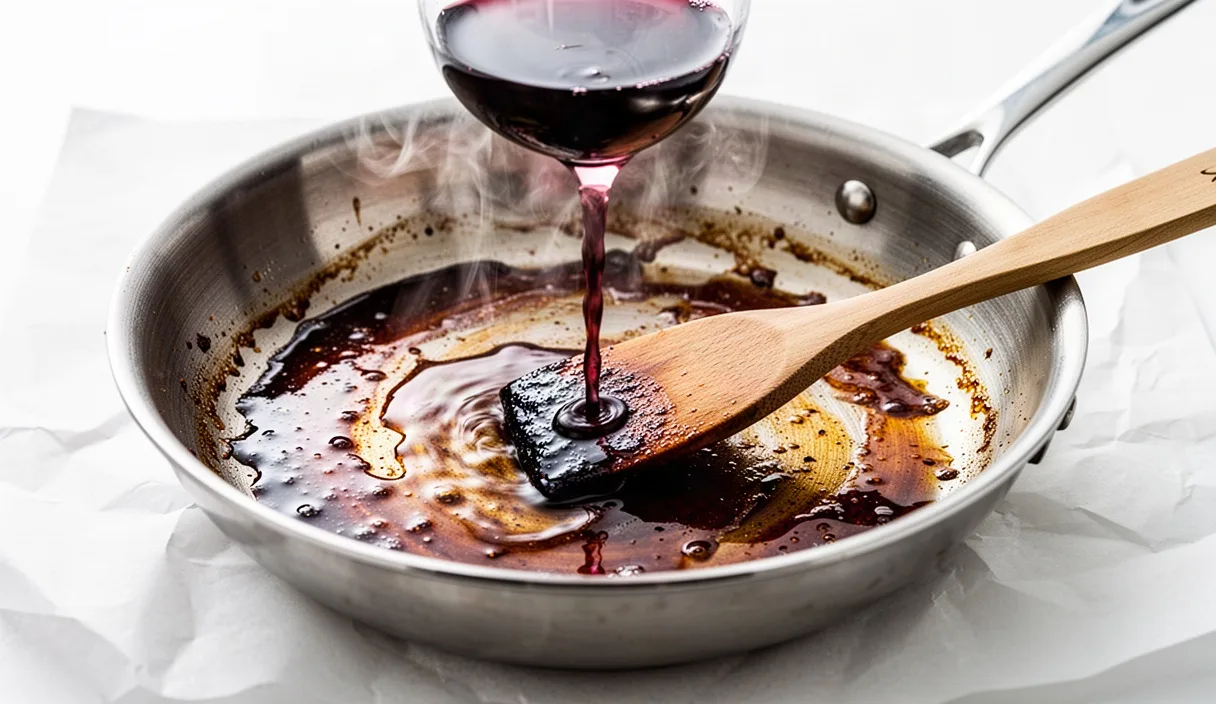
Deglazing is the thermodynamic hinge of pan saucing. When we pour room-temperature or cool liquid across hot metal, the pan undergoes an immediate drop in surface temperature through rapid evaporative boiling. The liquid converts to steam at 212 degrees Fahrenheit, ballooning under the hardened layer of fond, loosening its mechanical grip on the microscopic pores of the stainless steel. The choice of deglazing liquid dictates both the chemical extraction of flavor and the balance of acidity.
- Dry Wine: Red wines (such as Pinot Noir or Cabernet Franc) and crisp white wines (such as Sauvignon Blanc or un-oaked Chardonnay) provide tartaric and malic acids. These acids cut through the dense animal lipids left in the pan. The alcohol helps dissolve fat-soluble flavor compounds that water alone cannot free.
- Gelatin-Rich Broth: Unsalted chicken, veal, or beef stock brings water for dissolution and natural collagen for body. A stock made by simmering knuckles and feet yields natural gelatin that gives the finished sauce a glossy, clingy texture once reduced.
- Cider or Wine Vinegar: Used in smaller quantities, usually two to three tablespoons diluted with water or broth, vinegar introduces acetic acid. This works exceptionally well for rich poultry, pork tenderloin, or oily fish where a bright, sour prick is required to balance the palate.
Pour the liquid all at once, not in a hesitant drizzle. Adding between a third of a cup and a half cup of liquid creates a uniform steam blanket. A hesitant trickle will merely evaporate on contact and burn, whereas a deliberate pour rapidly cools the pan metal to the boiling point of the liquid, arresting any further browning of the fond.
Scraping the Skillet Base with a Flat Wood Spatula
The introduction of liquid creates the thermal conditions for deglazing, but physical abrasion completes the work. We reach for a straight-edged wooden spatula, preferably crafted from cherry, maple, or beechwood. Metal spoons can gouge the pan or leave sharp marks, while silicone spatulas are too pliable to scrape against baked-on proteins with the necessary firmness.
As the liquid bubbles furiously, we bring the beveled wooden edge across every millimeter of the pan base. We work in rhythmic, overlapping strokes from the outside edge toward the center. You will feel the texture through the wood handle: at first, the spatula encounters rough, bumpy resistance as it catches against the bonded meat sugars. Within twelve to fifteen seconds of scraping through boiling liquid, that resistance vanishes. The metal beneath turns silky and smooth under the edge of the tool.
Do not ignore the transition corners where the vertical sidewall of the skillet curves into the flat floor. Fond frequently accumulates in this radius and dries out faster than the fond in the direct center. Angle the corner of your flat spatula into this groove, running it completely around the circumference to lift those concentrated deposits into the simmering liquid.
Reducing Liquid to a Glaze That Coats a Spoon
Once the fond is fully dissolved into the liquid, we shift our thermal management from rapid cooling back to controlled reduction. The goal here is concentration. We want water to vaporize while retaining flavor compounds, acids, and gelatins. We keep the pan over a medium flame, maintaining an active, bubbling simmer across the entire surface rather than a localized boil in the center.
As water molecules leave the pan, the bubbles change in size and sound. Early in the reduction, the bubbles are small, watery, and break instantaneously with a light hissing sound. As the sugars, gelatin, and soluble proteins concentrate, the boiling liquid turns more viscous. The bubbles grow larger, expanding across the surface like molten glass, and pop with a slower, duller sound. This transition indicates that you have reached the stage the French describe as nappe.
To verify the reduction, we use the back of a cool stainless steel spoon:
- Dip the convex back of the spoon halfway into the bubbling reduction and lift it horizontally.
- Allow the liquid to rest on the metal for two seconds. It should coat the back of the spoon evenly without immediately running off like water.
- Draw the tip of your index finger cleanly through the sauce on the spoon.
- Inspect the line: if the edges of the path remain sharp and separated without the sauce flooding back together, the liquid has reduced sufficiently.
At this stage, your volume should be reduced to roughly two to three tablespoons of concentrated, syrupy glaze. If the liquid reduces past this point, the sugars will begin to caramelize a second time, risking scorching and causing the final sauce to become gummy.
Mounting with Cold Butter for Sheen and Stability
The final step in classic pan saucing is mounting, known technically as monter au beurre. This is not simply melting fat into a liquid; it is the physical formation of a temporary water-in-fat emulsion. Whole butter consists of approximately 80 to 82 percent milkfat, 16 to 18 percent water, and 1 to 2 percent milk solids. The milk solids act as a natural emulsifying agent, binding the warm aqueous reduction to the liquefied fat globules.
Thermal control during this final minute is absolute. The reduction cannot be boiling when the butter is introduced. If the temperature exceeds 190 degrees Fahrenheit, the emulsion will separate: the milk solids will curdle, the water will boil off, and the butterfat will break into a greasy, yellow puddle on top of the sauce. We turn the burner off entirely or drag the skillet half off the flame so that the reduction settles into an unmoving, steaming liquid.
Cut cold butter, straight from the refrigerator at roughly 38 degrees Fahrenheit, into half-inch cubes. Add one or two cubes at a time. Do not stir passively; swirl the skillet continuously by its handle while whisking gently with a small sauce whisk or your flat wooden spatula. The cold butter must melt gradually from its outer surface, dispersing tiny droplets of fat into the warm reduction while keeping the overall temperature of the sauce below 160 degrees Fahrenheit. The result is a sauce that transforms from translucent and watery to opaque, creamy, and intensely glossy, holding enough body to cling gracefully to warm meat without pooling into water on the plate.
Common Mistakes
- Deglazing a Scorched Pan: Attempting to save blackened bits by adding liquid simply infuses the entire reduction with bitter carbon. If the fond is black, wipe the pan clean and begin fresh.
- Using Warm Butter to Mount: Softened or room-temperature butter melts too quickly, releasing its fat before it can be dispersed mechanically. Butter must be cold and firm.
- Simmering After Mounting: Returning the pan to a vigorous boil after the butter has been incorporated destroys the emulsion, causing the sauce to break into separated oil and broth.
- Over-Salting Early: As stock and wine reduce down to a third or a quarter of their initial volume, sodium levels concentrate dramatically. Never season your pan sauce with salt until the final butter has been fully integrated.
Next Steps at the Stove
To master the physics of pan saucing, begin by testing heat thresholds on a simple pan of chicken thighs. Chicken provides ample skin gelatin and clear rendered fat, producing light amber fond that allows you to observe color shifts clearly. Prepare your mise en place before cooking: measure three tablespoons of white wine or vermouth, a third of a cup of unsalted chicken stock, and cut two tablespoons of cold butter into three cubes, keeping them chilled in a small dish until the moment of use.
Pay close attention to the acoustic shift when the meat leaves the metal. Learn the difference between the dry, urgent sound of fat frying against bare steel and the gentle simmer of deglazing liquid. Keep your flat-edged wooden spatula resting alongside the stove, and practice shifting the skillet between active heat and cool metal until you can stop a reduction at the exact line of nappe with confidence.