When we bring home a wedge of Comté, a firm alpine Gruyère, or a crumbly wedge of two-year-old clothbound Cheddar, we hold the result of months of patient cellar labor. The wheel was turned on spruce boards, brushed with brine, and brought through slow fermentations until the milk sugars converted into complex lactic acids, tyrosine crystals, and savory esters. The dense, pale paste feels cool and firm in the hand, carrying a faint aroma of browned butter, toasted nuts, and cellar stone. It is an edible archive of grass, season, and bacterial culture.
Too often, this craftsmanship meets an abrupt end on a cutting board when we pull a sheet of polyethylene cling film over the cut face. Sealing an aged curd in impermeable plastic arrests its development and smothers the very microbes that gave it character. To keep hard cheeses in sound condition on our pantry shelves or in our domestic larders, we need storage methods that mirror the cellars where they matured. By trading plastic film for natural papers, linen, and controlled microclimates, we allow the cheese to breathe, shed moisture naturally, and retain its crystalline texture.
The Biological Respiration of Aged Curds
A wedge of hard cheese is not an inert slab of fat and protein. Even after twelve or twenty-four months of aging, the interior paste remains biologically active. Hard cheeses generally hold between 31% and 37% water by weight. Within that dry matrix, residual enzymes continue to split milk proteins into shorter amino acid chains, while ambient yeasts and bacteria on the rind consume trace compounds, releasing microscopic amounts of carbon dioxide and moisture vapor into the surrounding air.
This process of slow biological respiration requires an open atmosphere. As water vapor leaves the cheese, oxygen must enter in minute volumes to prevent anaerobic breakdown. When the paste respires at a steady rate, the moisture gradient across the wedge remains balanced: the cut face stays supple without turning damp, and the hard outer rind remains dry enough to defend against invasive bacterial rot. If we disturb this equilibrium, the structure of the cheese shifts rapidly.
Temperature directly governs this respiration rate. At 38 degrees Fahrenheit, the metabolism of the cheese slows down, but does not halt. At 54 degrees Fahrenheit, typical of an affinage cave, respiration quickens, releasing volatile aromas that give alpine and cheddar styles their distinctive punch. When we store hard cheeses at home, our task is to maintain a slow, steady respiration that preserves the moisture balance without letting the fats pool on the surface or the paste turn chalky from dehydration.
Why Plastic Seals Destroy Delicate Rind Flora
Plastic cling wrap is engineered to be an airtight, vapor-proof membrane. While that quality suits fresh stocks and doughs, it ruins an aged curd within forty-eight hours. When we wrap a cut piece of Parmigiano-Reggiano or Manchego in plastic film, the water vapor escaping from the cut face has nowhere to go. It hits the non-porous plastic, condenses into liquid droplets, and settles back onto the surface of the cheese.
This trapped liquid creates an anaerobic microclimate against the cut paste. Deprived of oxygen, the beneficial surface flora dies back, and opportunistic, anaerobic bacteria take hold. The proteins on the surface begin to putrefy rather than age, producing an acrid, ammoniated odor that penetrates deep into the interior fat. At the same time, the trapped warmth and moisture pull free butterfat out of the protein emulsion, leaving a slick, greasy film across the cut face that cannot be reabsorbed.
| Storage Variable | Plastic Cling Film | Parchment or Wax Paper | Damp Linen Wrap |
|---|---|---|---|
| Oxygen exchange | Near zero; encourages anaerobic bacteria | Controlled, micro-porous diffusion | High diffusion through woven fibers |
| Moisture dissipation | Trapped; causes condensation and slime | Slow evaporation without dehydration | Regulated evaporation via fabric buffer |
| Fat migration | Draws oils to surface; greasy texture | Absorbs excess surface oil cleanly | Maintains emulsion without oil pooling |
| Rind health | Softens, rots, and develops off-odors | Retains original dryness and hardness | Stays stable under balanced humidity |
Beyond the breakdown of texture and aroma, plasticizers can migrate directly into the lipophilic dairy fats. Cheeses stored against soft vinyl or polyethylene for more than three days often pick up a flat, synthetic note that masks the grassy, herbal qualities of the milk. Stripping away the plastic is the first act of respect we can pay to a well-made cheese.
Folding Parchment for a Breathable Barrier
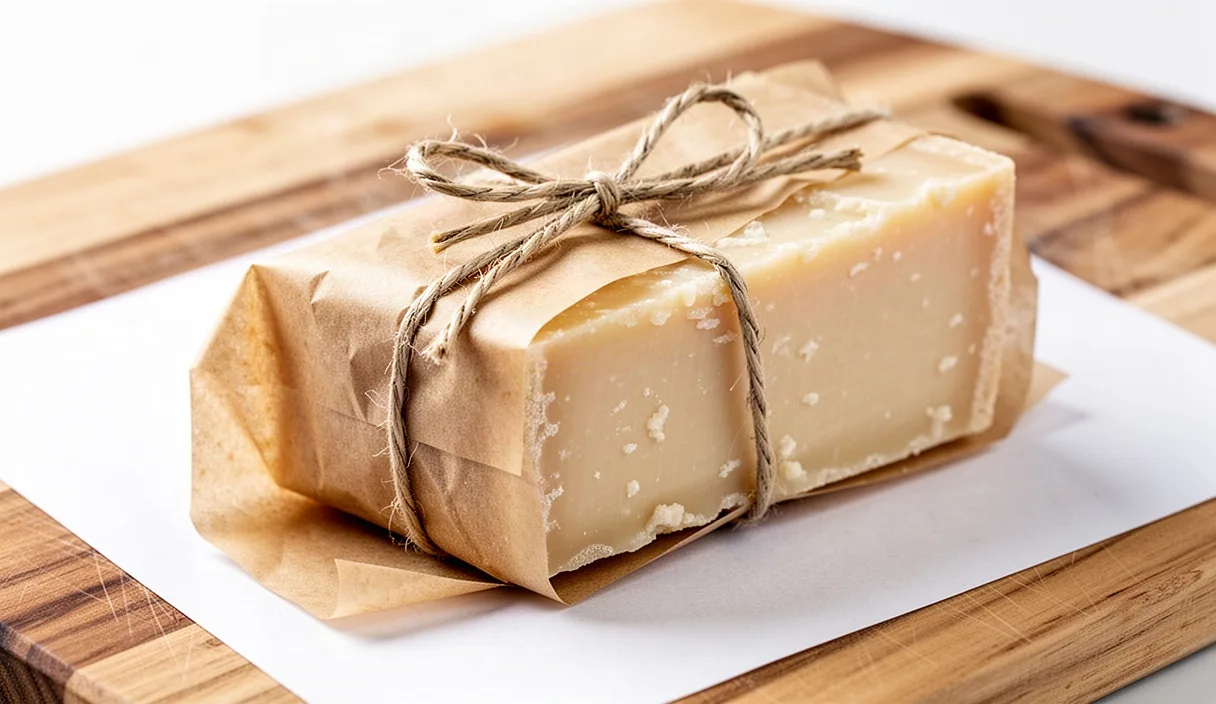
The simplest, most reliable material for wrapping everyday cuts of hard cheese is unbleached, silicone-coated parchment paper, or traditional cheese paper coated with micro-perforated wax. These materials provide a mechanical shield against refrigerator odors while allowing moisture vapor to move outward at a measured pace. The process relies on folding rather than adhesive tension.
To wrap a wedge cleanly, we treat the paper like cloth, tailoring it to the geometry of the curd. Follow these steps to secure the cut without suffocating the paste:
- Sizing the sheet: Cut a square of parchment roughly three times the surface area of your cheese wedge. An eight-ounce wedge typically requires a sheet measuring twelve inches by twelve inches.
- Positioning the spine: Lay the parchment flat on a clean wooden board. Place the cheese wedge in the center, resting on its thickest rind edge with the pointed cut nose facing directly toward you.
- Drawing the paper upward: Bring the bottom edge of the paper up over the nose of the wedge, pulling it flush against the cut sides without tearing the sheet on sharp crystalline edges.
- Creasing the package corners: Fold the side flaps inward toward the center, creating crisp, flat diagonal creases much like wrapping a tailor's box. The paper should hug the flat faces of the cheese snugly.
- Tucking the tail: Fold the remaining top flap down over the rind. Tuck the loose paper tail beneath the wedge so the weight of the cheese itself holds the fold shut. Avoid tape or tight rubber bands, which compress the paste and pinch moisture into localized zones.
If you plan to store the wrapped wedge in a refrigerator for more than six days, place the parchment-wrapped package inside a loosely folded paper bag or an unsealed glass container. This extra layer buffers against the drying drafts of the appliance fan while maintaining an open exchange of air.
Damp Linen Wraps for Whole Wheel Segments
When dealing with larger pieces, such as a three-pound heel of Pecorino Romano or a quarter-wheel of mountain cheese, parchment can be too brittle and narrow. For these substantial cuts, we turn to unbleached linen or heavy cotton muslin. Textile wraps mirror the damp cloths used by affineurs in European maturing rooms, functioning as a sacrificial moisture layer that insulates the core paste.
The cloth must be prepared with care to avoid introducing mold spores or sour odors. We boil the linen in plain water for twelve minutes to sterilize the weave, then allow it to cool completely. Prepare a mild brine by dissolving sixteen grams of coarse sea salt into one quart of filtered water. Dip the clean linen into the brine, then wring it out with firm pressure until it feels cool and barely damp, with no free water dripping from the fibers.
Wrap the cloth smoothly around the wedge, covering both the exposed cut paste and the natural rind. The light salt presence in the fibers inhibits the growth of unwanted molds on the cloth itself, while the damp flax fibers hold humidity against the cheese without forming a liquid film. Check the linen every three or four days. If it feels brittle or dry to the touch, remoistens it with a few drops of boiled, cooled brine before re-creasing it around the curd.
Selecting the Coolest Humid Spot in the Fridge
Modern frost-free refrigerators are designed to suck moisture out of the air to prevent ice accumulation on cooling coils. This continuous airflow is lethal to exposed dairy curds, pulling hydration out of a cut face within hours. At the same time, the standard main-shelf temperature of 35 to 37 degrees Fahrenheit numbs the fat and puts volatile flavor molecules to sleep.
We need to locate the small microclimate within the refrigerator that offers the highest relative humidity and the most stable, moderate temperature. In almost all home appliances, this zone is the vegetable crisper drawer. When the drawer is partially filled with root vegetables or greens, transpiration creates an enclosed atmosphere with a relative humidity between 72% and 82%, paired with an average temperature of 42 to 46 degrees Fahrenheit.
To refine this environment further, we can construct a dedicated cheese box to sit inside the crisper. Take a glass or unglazed ceramic dish, place a small untreated wooden slat or a folded dry paper towel at the bottom, set your wrapped cheese on top, and set a loose lid over the vessel. The lid must not seal hermetically; leave a corner cracked open by two or three millimeters to vent excess gas. This arrangement buffers the cheese against the cycle of the refrigerator compressor, keeping the air calm, cool, and humid.
Dealing with Harmless Blue Surface Bloom
Even with thoughtful wrapping and humidity control, natural molds may appear on the cut face of a hard cheese after two or three weeks. In home kitchens, this sight often prompts people to discard good food. With hard, low-moisture curds, however, surface bloom is almost always external, benign, and manageable.
Hard cheeses have a tight protein structure and low water activity, typically below 0.92 Aw. This density prevents fungal hyphae from penetrating into the core of the paste. Common surface blooms are usually strains of Penicillium roqueforti or Penicillium glaucum that drift naturally through the air from cellars, blue cheeses, or ambient flora. These molds appear as velvety patches of pale blue, sage green, or chalky white dust.
To clean an aged cheese that has developed surface bloom, take a clean, non-serrated chef's knife or paring blade:
- Inspect the growth under bright light. Benign molds are dry, velvety, and blue, grey, or white. If you observe slimy black spots, deep orange wet film, or bright red growths, discard the cheese, as these indicate bacterial contamination or high-moisture spoilage.
- Place the wedge on a stable cutting board. Hold the knife flat against the cut surface and trim away a thin shaving, roughly one-eighth to one-quarter of an inch deep, removing the mold patch entirely.
- Wipe the freshly exposed edge with a clean towel moistened with a light brine or a splash of white wine vinegar, which gently alters the surface pH to delay regrowth.
- Replace the wrapping paper with a fresh, clean sheet of parchment. Never wrap an exposed, newly scraped cheese back into the paper that carried the mold bloom.
If there is any doubt about the safety of an aged dairy product, or if the cheese displays off-odors reminiscent of rotten eggs, ammonia, or petroleum, it should not be consumed. Consult a local cheesemonger or an extension food safety specialist when evaluating unfamiliar molds on artisanal dairy products.
Common Mistakes
Caring for aged curds is an intuitive craft, but certain domestic habits repeatedly compromise good cheese:
- Leaving cheese in open air while cooking: Setting a wedge out on the counter while preparing a meal causes butterfat to sweat out rapidly once ambient temperatures exceed 68 degrees Fahrenheit. Cut what you need with a clean knife, re-wrap the block immediately, and return it to its cool spot.
- Using cross-contaminated cutting tools: Slicing hard cheese with a knife that recently touched bread, onions, or soft mold-ripened cheeses introduces foreign yeasts and bacteria directly onto the vulnerable cut face. Dedicate a dry, clean blade to your hard cheeses.
- Freezing hard cheese: Freezing forces water out of the protein network into ice crystals. When thawed, the curd structure collapses, shedding moisture and leaving the cheese crumbly, dry, and mealy, with its delicate aromatics flattened.
- Sealing in airtight plastic containers: Placing an unwrapped wedge directly into a snap-lock plastic tub produces the same sour, humid, anaerobic damage as cling film. If using a tub, line the bottom with raw wood or paper, and wrap the cheese in parchment first.
Next Steps in the Larder
Begin by inspecting the cheeses currently resting in your refrigerator. Pull away any cling film, evaluate the cut faces for moisture buildup or oiliness, and trim away any softened or discolored paste with a sharp blade. Prepare a dedicated drawer or an unsealed glass vessel to serve as your larder box, outfitting the base with a clean, folded sheet of parchment to catch stray moisture.
Keep a roll of heavy, unbleached parchment paper and a bundle of natural baker's twine in your pantry. As you bring new cuts of hard cheese into your kitchen, take the few minutes required to parcel-fold them cleanly. You will find that your cheeses maintain their true texture, crystalline bite, and deep cellar perfume down to the final sliver of rind.